
Insights
What Is PON? Passive Optical Networks, Explained
A field-level look at the architecture behind most new fiber-to-the-home builds, why cable operators are moving to it, and why "passive" doesn't mean simple to build.
The 60-second version
A passive optical network (PON) delivers fiber service to many customers from a single strand. An optical line terminal (OLT) at the headend sends light down one fiber to an unpowered splitter, which divides it out to dozens of homes or businesses, each ending at an optical network terminal (ONT).
"Passive" means there are no powered electronics between the headend and the customer. No amplifiers, no node power supplies, nothing in the field to plug in. That is why PON costs less to run and why the fiber placed today can carry tomorrow's speeds with only an electronics swap at each end. It is also why the quality of the build matters so much: in a passive network, every splice and connector counts against the light budget.
For most of the last two decades, cable broadband ran on hybrid fiber-coax: fiber to a neighborhood node, coax the rest of the way, with DOCSIS doing the heavy lifting. That model is under pressure. MSO broadband subscriber losses began in 2023 and have accelerated since, driven largely by fiber competitors offering symmetrical multi-gig service.
PON is the architecture most of those fiber networks run on, and it is now showing up inside cable footprints too. More than a third of cable operators have already deployed PON in some form, according to an Omdia survey.
Understanding what PON is, and what it demands in the field, is now table stakes for anyone planning an access network.
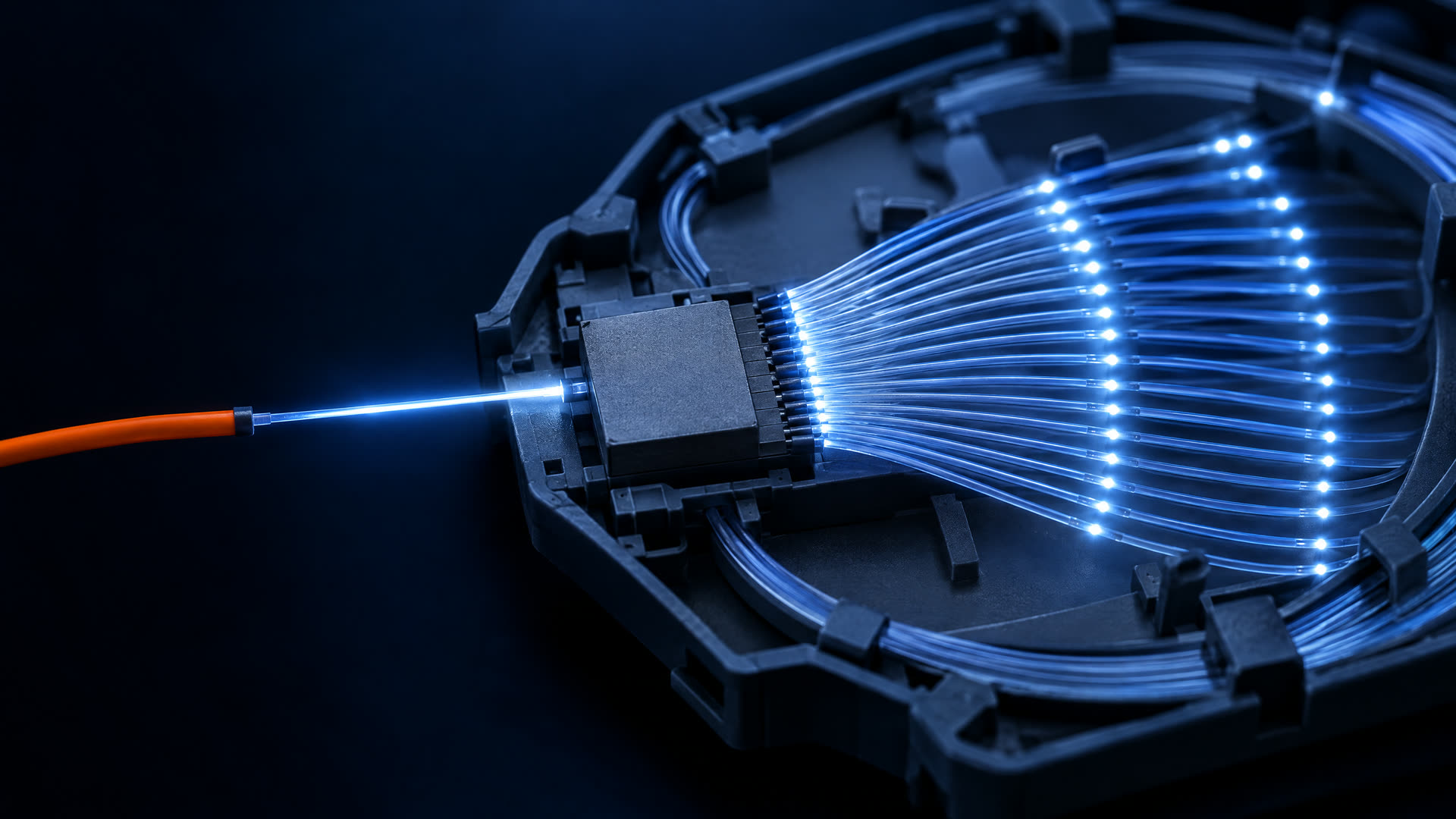
The splitter is the heart of a PON. It has no power supply, no fans, and no electronics. It divides light, and that is all it does.
How PON works
Every PON has three building blocks:
- The OLT sits at the headend or central office. It is the active equipment that sends and receives traffic for the whole network.
- The splitter sits in the field. A single fiber runs from the OLT to an unpowered optical splitter, which multiplies the signal and relays it to many endpoints.
- The ONT sits at the customer premises. It terminates the fiber and converts light into the Ethernet service the customer uses. (IEEE-based standards call it an ONU; same job.)
Traffic runs both ways on the same strand, using different wavelengths. For XGS-PON, downstream rides at 1577 nm and upstream at 1270 nm, and the splitter acts as a combiner on the way back. Downstream, the OLT broadcasts to every ONT on the splitter. Upstream, it assigns each ONT its own time slot so customers don't collide.
The PON family: GPON to 50G and beyond
PON is a family of standards, not a single technology:
| Standard | Capacity | Status |
|---|---|---|
| GPON | 2.5 Gbps down / 1.25 Gbps up | Widely deployed legacy base |
| XGS-PON | 10 Gbps symmetrical (~8.3 Gbps real-world) | Most widely deployed today |
| 25G-PON | ~21.5 Gbps real-world | Emerging differentiator |
| 50G-PON | 50 Gbps class | Designed to coexist with XGS and 25G on the same fiber |
| 100G-PON | 100 Gbps class | In trials |
XGS through 100G figures from the Fiber Broadband Association, May 2026.
The key point for network owners: generations stack. Because each standard uses its own wavelengths, several can run over the same fiber at once. Upgrading means changing the electronics at each end, not rebuilding the plant. Fiber placed today carries an expected service life of 50 to 100 years.
Why MSOs are moving to PON
The business case comes down to three numbers from the FBA's May 2026 whitepaper. FTTH operating expense is estimated at about 50% lower than HFC, because the outside plant has no amplifiers, nodes, or power supplies to maintain. Fiber subscribers also bring higher average revenue per user. And where fiber is available, more of a market's churn moves toward it.
One Ohio operator in the FBA case study has decommissioned about two-thirds of its HFC power supplies since early 2025 by converting neighborhoods to fiber in sequence.
The path isn't all-or-nothing. Cable operators are choosing fiber for most greenfield builds, while some are also overbuilding legacy HFC areas with PON. Others are testing a mix of DOCSIS upgrades and PON market by market before committing.
The FBA outlines three models: a greenfield overbuild alongside HFC, selective fiber deepening, and a full fiber overbuild. During the transition, operators can run HFC and PON side by side on separate fiber, share fiber using different wavelengths, or build an overlay that takes over customers gradually.
Why "passive" doesn't mean simple to build
PON removes powered equipment from the field. It doesn't remove complexity; it moves it into design and construction.
- The light budget is fixed. Every splitter, splice, and connector takes a share of the optical budget between OLT and ONT. With no amplifier to make up the difference, a sloppy splice or dirty connector can push a customer out of spec.
- Splitter architecture is a design decision with long consequences. Where splitters sit, and how they cascade, sets how the network grows, how faults are isolated, and how easily it upgrades to the next PON generation.
- Documentation is the network. With dozens of customers behind one feeder strand, accurate port and splitter records are what make a fault findable.
- Testing changes. Fiber crews need splicing and OTDR testing skills, and coax drops have to be overbuilt with new fiber drops.
- Coexistence takes planning. Running PON and HFC on shared fiber requires careful wavelength planning and filtering.
In a passive network, there is no amplifier to hide a bad splice. Build quality shows up directly in every customer's light level.
How CUI builds PON
CUI Fiber Solutions has spent more than 30 years building and servicing MSO networks, and its leadership comes from operators including AT&T Broadband, Charter, Comcast, and TCI. That history covers both sides of the migration: the HFC plant operators are moving off of, and the all-fiber architectures they are moving to.
CUI delivers PON end to end: Design & Engineering for splitter architecture and loss budgets, OSP construction aerial and underground, MDU construction, and last mile drops and installs. Because CUI began in fulfillment, its crews know the customer-premises end of the network as well as the outside plant.
Frequently Asked Questions
What does PON stand for?
PON stands for passive optical network. It is a fiber access network that uses unpowered optical splitters to deliver service from one headend port to many customers over a shared fiber.
What is the difference between PON and HFC?
HFC runs fiber to a neighborhood node and coax to the home, with powered amplifiers and nodes in the field. PON runs fiber all the way to the premises with no powered equipment in between, which supports symmetrical speeds and lowers operating costs.
What is XGS-PON?
XGS-PON is a 10 Gbps symmetrical PON standard (ITU-T G.9807.1). The "X" stands for 10 and the "S" for symmetrical. It is currently the most widely deployed PON standard for new fiber builds.
What are OLTs, ONTs, and splitters?
The OLT is the active equipment at the headend. The splitter is the unpowered device in the field that divides one fiber into many. The ONT terminates the fiber at the customer and converts light into usable service.
Can a PON network be upgraded without new fiber?
Yes. PON generations use different wavelengths, so newer standards can run on the same fiber as older ones. Upgrades usually mean replacing electronics at the headend and premises, not the plant.
Why are cable operators moving to PON?
Fiber competitors offering symmetrical multi-gig service have pulled subscribers from HFC. PON lets MSOs match those speeds, cut field power and maintenance, and build a plant that upgrades through electronics alone.